Earlier this month, I watched a BBC Panorama investigation, Cancer Before 50: Why Is It Rising? It looked at why some cancers are being diagnosed more often in younger adults — which is pretty scary stuff.
Of course, this is a hugely complex subject and there isn't one simple answer. Researchers are looking at a range of possible contributing factors, including obesity and changes to the way we eat.
But two of the areas explored in the programme particularly interested me as a nutritionist: ultra-processed food (UPF) and our exposure to environmental chemicals.
Now, before you read on, I want to be clear that this isn't an article designed to frighten you into clearing out your kitchen cupboards, throwing away your Tupperware and replacing the entire contents of your bathroom cabinet.
My goal here is to help you understand what we're actually talking about when we use terms like ultra-processed food and environmental chemicals, what the research is encouraging us to pay attention to, and where there are sensible choices we can make without becoming obsessive.
What counts as ultra-processed food?
For starters, processed and ultra-processed aren't the same thing.
Technically, we process food all the time. Cooking, freezing, and tinning are all methods of processing. Milk is pasteurised to kill bad bacteria. So when you hear a blanket statement like “eat fewer processed foods”, that's not a particularly helpful instruction.
What is useful is understanding the different levels of processing and what they actually mean.
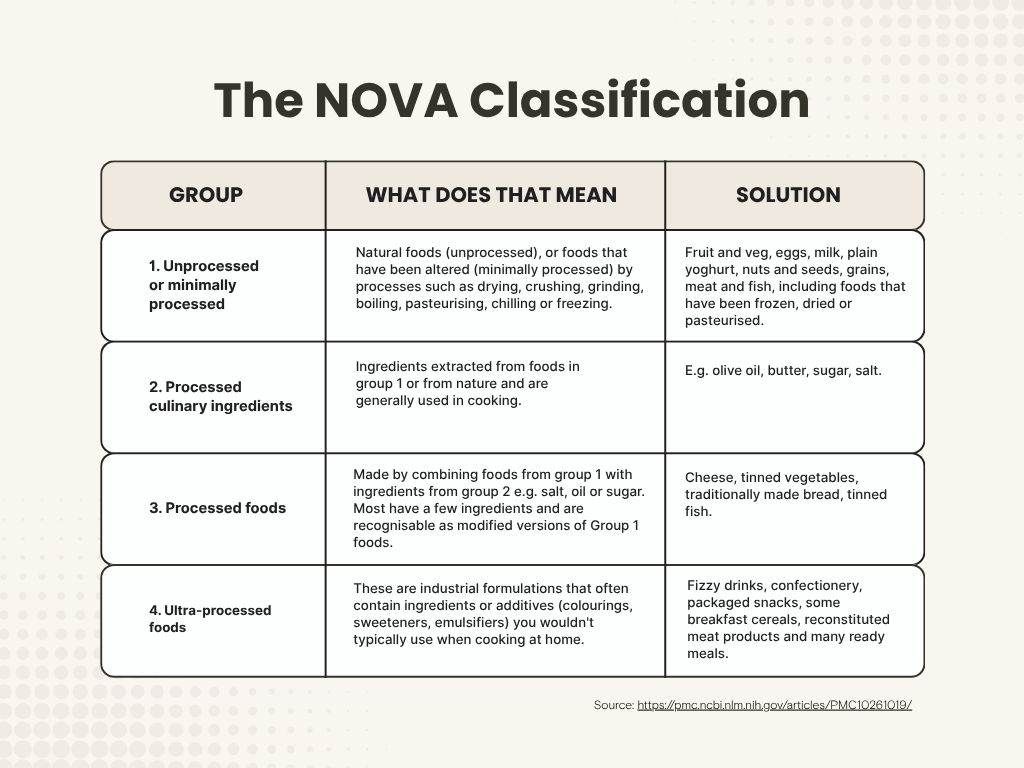
The system you'll most often see used in research is called NOVA.
NOVA divides foods into four groups depending on how (and how much) they've been processed.
In very simple terms, it looks like this:
Not all UPFs are nutritionally equal
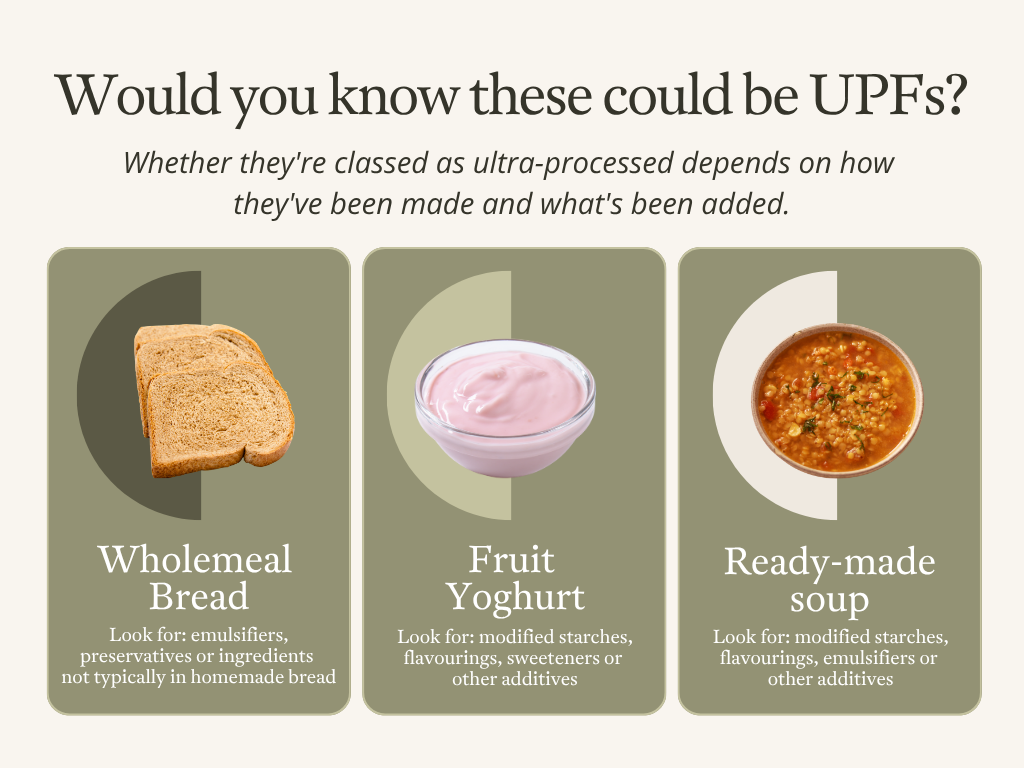
The UPF category is huge because it depends on the food's ingredients and how it is made. This means that a supermarket wholemeal loaf of bread can be classified alongside a packet of sweets or a fizzy drink (clearly, they’re not like for like nutritionally).
And this is why trying to achieve a completely UPF-free diet isn’t necessarily a useful goal, and neither is trying to cut every single UPF out of your diet.
Most of us aren't making our own bread and cereal from scratch — and lovely as the idea is, we don’t need to. A supermarket wholemeal loaf can be a useful source of wholegrains and fibre, and a fortified breakfast cereal can provide useful nutrients.
So I think it’s more useful to consider how much of your diet is made up of UPFs, and what else you're eating alongside them. Because eating plenty of whole and minimally processed foods, while also buying supermarket bread or having cereal for breakfast, is very different from a diet where UPFs make up the majority of what you eat.
So, what does this mean for our health?
Research has linked diets that are high in UPFs with a number of poorer health outcomes, including some cancers. But why that’s happening isn’t yet clear, and researchers are trying to understand it.
Several things could be going on. Diets that are high in UPFs tend to be lower in fibre and whole foods and can be higher in salt, sugar and saturated fat. But researchers are also looking at whether processing, certain additives and food packaging play a role.
In short, while we don't have all the answers yet, there’s good enough reason to pay attention to how much UPF there is in your diet.
Nitrates and nitrites
One area where the evidence is much clearer is processed meat. Foods like bacon, ham and sausages have been classified by the World Health Organization's cancer agency as Group 1 carcinogens. This means there’s enough evidence that eating processed meat causes bowel cancer.
You might have heard about nitrates and nitrites, because they’re often used as preservatives in processed meat. It’s worth understanding, though, that nitrates also occur naturally in vegetables such as spinach, lettuce, celery and beetroot — these foods, however, aren't associated with the same increased cancer risk.
Nitrates and nitrites added to food have to be labelled with their function (e.g., ‘preservative’) and their full name or E number. In processed meats, these include E249–E252. So, for example, you might see:
Preservative: Sodium nitrite, Potassium nitrite, or
Preservative: E250, E249
What about the chemicals we're exposed to?
The other part of the Panorama investigation that I found interesting was our exposure to chemicals through the environment and everyday products. It's something I talk about quite a lot with clients, particularly those interested in fertility.
You may have heard about PFAS or “forever chemicals”, bisphenols such as BPA, phthalates and microplastics, among others. As with UPFs and cancer, there are still lots of unanswered questions here, but this isn't simply another wellness trend either. For example, PFOA — one of the PFAS family — has been classified as carcinogenic to humans.
What we don't yet fully understand is what our long-term exposure to lots of different chemicals might mean for our health.
Again, I don't think the answer is to panic or try to remove every possible chemical from your life. There are, however, some relatively simple ways to reduce your exposure.
I've written about this in more detail in my article Women’s hormone balance: simple ways to reduce toxins, including what to look out for in everyday products and some of the tools and apps, such as Yuka, that can help you make more informed choices.
What can you actually do?
There are a few sensible things to take away from this:
Ideally, whole and minimally processed foods should do most of the heavy lifting in your diet. That doesn't have to mean cooking everything from scratch. Frozen veg, tinned beans, canned fish and other simply processed foods can make this much easier.
Add good stuff. Adding more fruit and veg, wholegrains, nuts, seeds and other fibre-rich foods will be considerably more useful than obsessing over whether every food in your cupboard is a UPF.
Look at the overall pattern. One biscuit isn't the issue (hooray!). Neither is a supermarket loaf of bread or an emergency ready meal. Consider what your diet looks like across a week?
Check labels without becoming frightened of them. An unfamiliar chemical name doesn't automatically mean something’s harmful. For example, ascorbic acid is the chemical name for vitamin C.
Take some sensible steps to reduce environmental exposures. You don’t have to throw everything that you own away. For some tips see Women’s hormone balance: simple ways to reduce toxins
Food for thought
This Panorama programme has certainly given us plenty to think about — and I think that's a good thing. We want to look after our bodies and make choices that support our health. But we don't want to become frightened of food or overwhelmed by everything.
Knowledge is definitely power here, and the more we understand about where some of the risks lie, the better equipped we are to make informed choices and reduce them where we can.
That's really what I want you to take away from this.